

It's Sunday, November 15, 2-26. Nvidia is searching for a new leader after Jensen Huang's exit exposed a board that never planned for life without him, and the fallout has reached Washington, where Treasury Secretary Scott Bessent pointed the finger at Howard Lutnick's Commerce Department. Meanwhile, US wholesale prices are climbing at their fastest pace in nearly four years, and Americans are heading into the holidays with record credit card debt. Let's get into it.

Market Recap
We saw a nice bounce back in the markets this week, recovering most of last week's post-election losses. Stocks rallied to open on Monday as oil prices fell, and the Nasdaq 100 jumped on Wednesday after strong CoreWeave results revived the AI trade. We lost that momentum late in the week as the big story, Jensen Huang's exit from Nvidia, weighed on hotter inflation readings and locked in expectations for a December Fed hike, while falling metals prices held the TSX back.
From a returns perspective, the Nasdaq 100 led the way with an impressive 3.53% gain, followed by the S&P 500 at 2.51% and the Dow Jones at 2.07%. The TSX lagged with a gain of 0.89%.

Stocks in the Spotlight
Advanced Micro Devices ($AMD) gained 18.9% this week as investors moved money toward Nvidia's rivals, starting with a 13.3% jump on Monday after Nvidia's board opened its investigation into Jensen Huang. An upgrade to Outperform from Oppenheimer, with a US$600 price target, added to the move, and Broadcom ran right alongside it with an 18.2% weekly gain.
Celestica ($CLS) rose 17.2% this week, winning back much of last week's 20.9% drop as Canadian tech rebounded with the AI trade. The data centre hardware maker led the TSX's 657-point rally on Monday and added another 4.8% on Thursday, holding up even as Nvidia's chief executive stepped down.
CoreWeave ($CRWV) gained 14.5% this week after third quarter revenue of US$3.66 billion beat estimates and management raised its full-year revenue guidance to between US$13.0 billion and US$13.3 billion. The stock jumped 24.7% on Wednesday alone, although it gave back part of that gain over the last two sessions.
Cargojet ($CJT) climbed 13.8% this week, including a jump of more than 10% on Thursday that made it the TSX's top performer after record third quarter revenue. Revenue rose 30.3% from a year earlier on growth in its domestic network, aircraft leasing and charters, and net profit more than doubled to $19.1 million.
Nebius Group ($NBIS) fell 10.5% this week, including a 16.8% drop on Thursday, even though third quarter revenue jumped 571% to US$980.8 million and beat estimates. Investors focused instead on management's warning that 2026 revenue will land at the low end of its US$3.0 billion to US$3.4 billion range, as some third-party capacity slips into 2027.
Economic Vital Signs
THE QUICK READ
If October's consumer price report could speak, it wouldn’t have minced words: US inflation isn't cooling fast enough for the Fed to stand still.
US Inflation Rate and Core Inflation Rate (how fast consumer prices are rising, with and without food and energy): prices rose 0.4% in October and core prices rose 0.3%, both above forecasts.
THE FULL DETAILS
Core Inflation Holds at 0.3% for a Third Straight Month


The consumer price index rose 0.4% in October, down from 0.6% in September but above the 0.3% economists expected, while core inflation matched September's 0.3% pace against forecasts for 0.2%. Shelter accounted for more than 30% of the monthly increase, and the BLS couldn't publish yearly rates because the 2025 government shutdown left it without October 2025 prices.
Energy: up 0.7%, a sharp slowdown from September's 5.2% jump
Food: up 0.5%, after no change in September
Gasoline: up 37.4% from a year earlier, one of the few yearly figures published
Used cars and trucks: down 1.2% on the month
TOP INSIGHTS
Core Inflation Answered Last Week's Question
In last week's Pulse, I said a monthly core reading of 0.3% or higher would all but settle a December Fed hike, and October came in right on that line. Fed Governor Christopher Waller said this week that a core reading around 0.3% or higher should put a half-point increase on the table, so the debate has moved from whether to raise, to how much to raise.
CME's FedWatch tool now puts the odds of a quarter-point hike on December 9 at 89.7%, up from 76.8% a week ago, and futures no longer price any chance of a hold.
It looks like a quarter-point hike is now the base case. Another thing that will be interesting: whether the Fed hints at more, since November's inflation report comes out the day after the decision.
Three Months at 0.3% Adds Up to Almost 4%
Without an official yearly figure, (because of the shutdown last year) the monthly readings need to carry the story, and they've been remarkably steady. Compounded, the last three months put core CPI on an annualized pace of about 3.7%, well above the 2.6% yearly rate published for September and still far from the Fed's 2% goal, which it measures with a separate gauge, the PCE price index.
Bond markets are reacting, with the 10-year Treasury yield touching 5.17% on Friday as traders priced in a longer run of tightening.
It now looks more likely that the Fed keeps going into early 2027 rather than hiking once and pausing, and markets are already leaning toward another increase in January.
Paycheques Are Only Treading Water
Released alongside the inflation numbers, real average weekly earnings were flat in October after falling 0.4% in September. Pay is still rising, but once prices are factored in, the typical US worker isn't getting ahead.
That puts more of the load for consumer spending, roughly two-thirds of the US economy, on savings and credit.
Tuesday's October retail sales report will be important. A soft number would be evidence that the squeeze on households is starting to show up at the cash register, just as the Fed tightens further.
THE WEEK AHEAD
Canada's Inflation Rate and Core Inflation Rate for October are out Monday, with economists expecting prices to rise 0.3% on the month and 3.2% from a year earlier, a key test for the Bank of Canada after weak jobs data cooled talk of another hike.
US Retail Sales for October are due Tuesday, with a 0.2% monthly gain expected, and they'll show whether flat real wages and record card balances are finally slowing shoppers down.
Michigan Consumer Sentiment for November gets its final reading Friday, after a preliminary 51.0, and it'll be the first to capture the midterm results and the AI sell-off, since the early survey closed on November 2.
TOP STORY | CORPORATE GOVERNANCE
Nvidia Had No Plan B for Jensen Huang

Nvidia shed over US$1 trillion in market value since October
Huang led Nvidia for 33 years before this week's ouster
CFO Colette Kress is running the company as interim CEO
Nvidia had no formal board chair until Huang left
In a massive shock to the tech sector, the world's most important AI chipmaker just lost its founder and chief executive to a scandal, and it turns out nobody had planned for the day he'd leave. Jensen Huang's affair with Alice Huang (no relation), a woman US intelligence officials suspected of working for China, ended a run that turned a small video game graphics company into an AI giant. The bigger failure may belong to a board that treated him as untouchable, even as his daughter Madison rose into the executive ranks. The sell-off also cost Nvidia its title as the world's most valuable company, which now belongs to Apple.
Rich Employees Don't Rock the Boat
Nvidia's employee stock plan let staff buy shares at a 15% discount, minting thousands of millionaires who had little reason to question the boss. Even though Huang was already in his 60s, the board had no succession plan ready.
Other Founder-Led Giants Should Take Note
Hewlett-Packard, Coca-Cola, Uber and Starbucks all stumbled through messy handovers, and their investors paid for it in strategic confusion and weak returns. Shareholders in Tesla, Meta and OpenAI will now be asking whether Elon Musk, Mark Zuckerberg and Sam Altman have real succession plans in place.
Full story here.

THIS WEEK’S POLL
Nvidia now has no permanent chief executive, a spy scandal that's still unfolding in Washington, and lawmakers calling for tighter limits on chip sales to China. Each of those could weigh on the stock in a different way, and some might fade faster than others. Now investors need to assess the biggest threat. Please vote on this week's question:
What's the biggest risk for Nvidia shareholders right now?
LAST WEEK’S POLL RESULTS
In last week's poll, I asked how long it will take Canada to cut its reliance on US trade in a significant way, and 52% said more than 10 years, 41% said five to 10 years and just 7% expected it within five. Our community clearly sees diversification as a long haul. Thanks to everyone who voted.

READER COMMENTS
A Decade or Longer
“I’m not an economist, but it just makes sense.” — elsiebeavis
“I only clicked on ten years because there was no other option. We have two years till Trump is out of office, and I believe a more sane approach to trade will prevail. There's nothing wrong with shopping around for the best price, but the price has to be pretty high to make it make sense to ship it around the world. Carney's political rhetoric is just BS. I'm in the camp that there won't be anyone working on any infrastructure by the next election.” — storierod
“Big exports will be oil, gas and minerals. Big losers will be smaller businesses and manufacturing, as shipping costs and times are greater than to the US. Also, they will have to contend with other countries' tariffs and non-tariff trade barriers.” — keenrg
EXPORT CONTROLS
Bessent Puts Lutnick on the Spot

Four agencies wanted Megaspeed blacklisted, but Commerce didn't act
Megaspeed sits at the centre of the Nvidia scandal
White House officials discussing whether Lutnick should be pushed out
Senate Banking chair wants Huang and Lutnick to testify
The Nvidia scandal has spilled into Washington, and Treasury Secretary Scott Bessent made it clear this week that his department isn't planning on taking the blame. Bessent told CNBC that Treasury, the Pentagon, the State Department and the US Trade Representative had pushed for months to put the Singapore company Megaspeed on the trade blacklist, but the Commerce Department makes the final call. Megaspeed is where Alice Huang, the former executive US authorities suspect of spying for China, once worked.
Nvidia's Due Diligence Is Next in Line
Bessent turned the question back on Nvidia, asking whether it really knew its client or was selling to obvious pass-through shell companies. He said anyone at the company responsible for that should be held accountable.
Tighter Chip Rules Look Likely Either Way
Lawmakers are already calling for tougher limits on China's access to advanced AI chips, though Bessent insists the government has all the authority it needs and just has to use it. Either path points to stricter enforcement, which could squeeze Nvidia's sales channels in Asia long after the leadership question is settled.
Full story here.
INFLATION
Wholesale Prices Climb at Fastest Pace Since 2022

Producer prices rose 6.5% from a year earlier in October
Monthly wholesale prices up 0.3%, slowing from September's 1.4%
Wholesale food prices jumped 1.3% on the month in October
Diesel sits at $6.06 a gallon, up about 61%
The prices US businesses pay their suppliers are rising at a pace not seen since the pandemic's aftermath, and that pressure has a tendency to work its way onto store shelves. As I just noted in the economic update above, consumer prices also ran hotter than expected this week, so both ends of the supply chain are telling the same story. Energy costs paused in October after a big spike the month before, but they stayed elevated, and the Iran war's hit to fuel prices hasn't faded.
Grocery Bills Are the Pressure Point
Diesel feeds into the cost of moving almost everything sold in stores, which helps explain why food is where wholesale inflation is showing up fastest. The yearly reading did come in a touch below the 6.6% economists expected, but that's little comfort at the checkout.
A December Hike Looks Locked In
Markets now put the odds of a quarter-point Fed hike in December at about 89%, which would be the central bank's second increase in four months. That follows three years without a single hike, a sharp turn for a Fed that was cutting rates just a year ago.
Full story here.
CONSUMER DEBT
Holiday Shoppers Start the Season Deep in Debt

US credit card balances hit a record $1.29 trillion last quarter
Total household debt climbed to $19.1 trillion in Q3
Savings rate has fallen below 4% of total income
CNBC/NRF retail gauge rose just 0.2% in October
Americans are heading into the holiday shopping season carrying more credit card debt than ever, just a week after affordability helped decide the midterm elections. Prices have climbed sharply since the pandemic, and many households have burned through their savings and leaned on credit to cover the gap. Kraft Heinz's CEO described the consumer as being in a fragile state, and the company plans to hold off on big price increases to keep shoppers on board.
Debt Counsellors Are Busier Than Ever
Money Management International says the past two months were its busiest for debt management plan sign-ups in more than 15 years. Its analyst Ted Rossman says most card debt starts with one surprise bill, like a medical expense, a leaky roof or a broken-down car.
Jobs Are the Last Line of Defence
Employment growth has steadied at an average of 137,000 a month over the past three months, which economists see as the main thing keeping spending from falling off a cliff. But with about 2 million Americans out of work for six months or more and McDonald's reporting its first quarterly US sales drop since early last year, that cushion looks thinner than it did.
Full story here.


Nvidia after Jensen Huang: Will Big Tech’s ‘key man’ ethos live on?

Ottawa stands by Darlington small modular reactor amid delays and rising costs

Microsoft 'deeply sorry' for global outage as it reports broad recovery

Why is Microsoft's outage lasting so long and will emails be lost?

An iconic puzzle comes home as production of the Rubik's Cube returns to Hungary
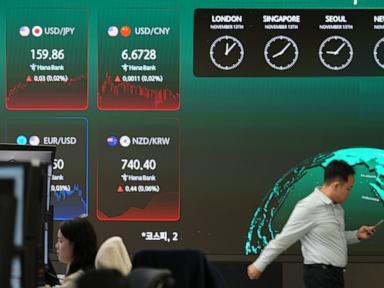
World shares log modest losses as investors assess impact on AI sector from the Nvidia scandal

Click any stock ticker to explore its page on Blossom Social. Review key financial data, learn more about the company, explore earnings information, and see what other investors in the community are saying.
Top 10 Weekly Gainers
US and Canadian stocks over $10B market cap, 5-day price change as of November 13, 2026. Prices shown in the currency of the listed exchange (CAD for TSX; USD for NYSE and Nasdaq)
Ticker | Company | Exchange | Price | 5-Day Change |
Cerebras Systems Inc. | NasdaqGS | $108.72 | +21.2% | |
DigitalOcean Holdings Inc. | NYSE | $86.32 | +19.1% | |
Advanced Micro Devices Inc. | NasdaqGS | $534.06 | +18.9% | |
Broadcom Inc. | NasdaqGS | $347.01 | +18.2% | |
Charter Communications Inc. | NasdaqGS | $138.39 | +17.2% | |
Celestica Inc. | TSX | $342.32 | +17.2% | |
Monolithic Power Systems Inc. | NasdaqGS | $1,390.54 | +16.8% | |
Astera Labs Inc. | NasdaqGS | $221.83 | +16.3% | |
Arista Networks Inc. | NYSE | $197.29 | +15.5% | |
Ciena Corporation | NYSE | $280.54 | +15.3% |
Top 10 Weekly Losers
Ticker | Company | Exchange | Price | 5-Day Change |
First Solar Inc. | NasdaqGS | $171.39 | -14.8% | |
Alibaba Group Holding Limited | NYSE | $94.38 | -13.8% | |
Strategy Inc | NasdaqGS | $111.62 | -13.4% | |
Pershing Square Inc. | NYSE | $44.71 | -13.1% | |
NVIDIA Corporation | NasdaqGS | $162.85 | -12.8% | |
Moderna Inc. | NasdaqGS | $223.37 | -12.1% | |
IonQ Inc. | NYSE | $28.88 | -11.5% | |
Endeavour Mining plc | TSX | $70.47 | -11.2% | |
Nebius Group N.V. | NasdaqGS | $115.88 | -10.5% | |
Rivian Automotive Inc. | NasdaqGS | $12.18 | -10.5% |
Most Overbought
US and Canadian stocks, Relative Strength Index as of November 13, 2026
Ticker | Company | Exchange | Sector | RSI |
ADT Inc. | NYSE | Consumer Discretionary | 84.8 | |
Procore Technologies Inc. | NYSE | Information Technology | 83.6 | |
Tradeweb Markets Inc. | NasdaqGS | Financials | 83.0 | |
The Clorox Company | NYSE | Consumer Staples | 82.6 | |
TMX Group Limited | TSX | Financials | 81.8 | |
Saputo Inc. | TSX | Consumer Staples | 81.6 | |
BBB Foods Inc. | NYSE | Consumer Staples | 81.4 | |
Edwards Lifesciences Corporation | NYSE | Health Care | 80.3 | |
AerCap Holdings N.V. | NYSE | Industrials | 79.9 | |
Veralto Corporation | NYSE | Industrials | 79.8 |
Most Oversold
Ticker | Company | Exchange | Sector | RSI |
F5 Inc. | NasdaqGS | Information Technology | 24.1 | |
NVIDIA Corporation | NasdaqGS | Information Technology | 24.9 | |
Ivanhoe Mines Ltd. | TSX | Materials | 25.4 | |
Halozyme Therapeutics Inc. | NasdaqGS | Health Care | 26.7 | |
Dynatrace Inc. | NYSE | Information Technology | 26.7 | |
Atlassian Corporation | NasdaqGS | Information Technology | 28.0 | |
Axon Enterprise Inc. | NasdaqGS | Industrials | 30.0 | |
NIO Inc. | NYSE | Consumer Discretionary | 30.4 | |
China Gold International Resources Corp. Ltd. | TSX | Materials | 31.1 | |
Datadog Inc. | NasdaqGS | Information Technology | 31.5 |
The Relative Strength Index (RSI) can provide a signal that suggests a stock is either overbought or oversold.
📈A stock that has an RSI over 70 is considered to be in “overbought” territory. This might suggest that the stock is due for a pullback, however it is not a recommendation to sell.
📉A stock that is trading with an RSI below 30 is considered to be in “oversold” territory. This might suggest that the stock is due for a recovery, however it is not a recommendation to buy. Always perform your own due diligence.
Stay connected with The Pulse

